- Search What are you curious about? Popular SearchesCritical thinkingPhilosophyEmotional IntelligenceFree Will Latest Videos Latest Articles
-
Topics
Philosophy
- Ethics
- Religion
- Flourishing
- Knowledge
- Philosophy of Science
- Philosophy of Art
- Language
- Political Theory
- Identity
- Meaning & Purpose
Science & Tech
- Physics
- Biology
- Aerospace
- Health
- Geology
- Computing
- Engineering
- Energy
- Biotechnology
- Astronomy
Mind & Behavior
- Psychology
- Neuroscience
- Decision-Making
- Mental Health
- Consciousness
- Emotional Intelligence
- Personality
- Relationships
- Parenting
Business
- Entrepreneurship
- Leadership
- Finance
- Marketing
- Innovation
- Strategy
- Management
- Artificial Intelligence
- Startups
- Economics
History & Society
- History
- Literature
- Art
- Music
- Film
- Progress
- Culture
- Sociology
- Policy
- Geopolitics
- Latest
-
Videos
Latest Videos
 How experimental archaeologists are resurrecting our forgotten past
with
Sam Kean
How experimental archaeologists are resurrecting our forgotten past
with
Sam Kean
 Why relationships in 2026 carry impossible expectations
with
Alain de Botton
Why relationships in 2026 carry impossible expectations
with
Alain de Botton
 Why toxic positivity is making us miserable
with
Kate Bowler
Why toxic positivity is making us miserable
with
Kate Bowler
 Why healthy love feels uncomfortable to so many people
with
Alain de Botton
Why healthy love feels uncomfortable to so many people
with
Alain de Botton
 Indigenous leadership is essential to climate action. Here’s why.
with
Skoll Foundation
Indigenous leadership is essential to climate action. Here’s why.
with
Skoll Foundation
 The tiny transistors remaking our global order
with
Chris Miller
See All
The tiny transistors remaking our global order
with
Chris Miller
See All
-
Columns
 Mini Philosophy
A philosophy column for personal reflection.
Mini Philosophy
A philosophy column for personal reflection.
 Starts With A Bang
An astrophysics column on big questions and our universe.
Starts With A Bang
An astrophysics column on big questions and our universe.
 Books
A literature column to feed your curiosity.
Books
A literature column to feed your curiosity.
 The Long Game
A business column on long-term thinking.
The Long Game
A business column on long-term thinking.
 Strange Maps
A geography column on history and society.
Strange Maps
A geography column on history and society.
 The Well
A collection of essays and videos on life’s biggest questions.
The Well
A collection of essays and videos on life’s biggest questions.
 13.8
A column at the intersection of science and culture.
13.8
A column at the intersection of science and culture.
-
Classes
Featured Classes
 Members
5 videos
The Humanity of Leadership
Simon Sinek
Ethnographer and author
Members
5 videos
The Humanity of Leadership
Simon Sinek
Ethnographer and author
 Members
7 videos
How to Lead With Integrity
Steve Stoute
Founder and CEO, UnitedMasters and Translation
Members
7 videos
How to Lead With Integrity
Steve Stoute
Founder and CEO, UnitedMasters and Translation
 Members
6 videos
Transform Your Organization with AI
Daphne Koller
Founder and CEO of insitro.
Members
6 videos
Transform Your Organization with AI
Daphne Koller
Founder and CEO of insitro.
 Members
10 videos
Unlocking Your Team’s Hidden Potential
Adam Grant
Organizational psychologist and author
Members
10 videos
Unlocking Your Team’s Hidden Potential
Adam Grant
Organizational psychologist and author
 Members
6 videos
The Secrets of Unreasonable Hospitality
Will Guidara
Restaurateur and Author, Unreasonable Hospitality
Members
6 videos
The Secrets of Unreasonable Hospitality
Will Guidara
Restaurateur and Author, Unreasonable Hospitality
 Members
12 videos
How to Afford Anything
Paula Pant
Host, Afford Anything Podcast, Afford Anything
Browse
Members
12 videos
How to Afford Anything
Paula Pant
Host, Afford Anything Podcast, Afford Anything
Browse
-
More
- Newsletters
- Monthly Issues
- Events
- Big Think+ Learning
- Creative Studio
- Advertise with Us
- About
- Careers
- View our Twitter (X) feed View our Youtube channel View our Instagram feed View our Substack feed
-
My account
- My Classes
- My Account
- My List
- BT+ for my Business
- Early Releases
- Sign Out
- Membership
- Latest
-
Topics
Back
Philosophy
Science & Tech
Mind & Behavior
Business
History & Society
-
Videos
Back
Latest Videos
How experimental archaeologists are resurrecting our forgotten past
Sam Kean examines how rogue archaeologists are recreating the sounds, tastes, smells, and practices of the ancient past.
Why relationships in 2026 carry impossible expectations
Now that love has been liberated, it seems to have become more complicated and more illusive than ever. Alain de...
Why toxic positivity is making us miserable
Toxic positivity isn’t optimism. It’s denial. Historian Kate Bowler explains why our obsession with “good vibes only” is making it...
Why healthy love feels uncomfortable to so many people
Alain de Botton argues that our romantic lives are shaped more by the emotional patterns we learned in childhood than...
Indigenous leadership is essential to climate action. Here’s why.
At COP30, Indigenous leaders came with a message the world can’t ignore: 5% of the global population is safeguarding 80%...
The tiny transistors remaking our global order
"The production of the silicon wafers that are used in the chip manufacturing process requires extraordinary levels of purity."
 The biological necessity of boredom in the age of screens
"I call it a tyranny of attention because there's so many demands on our attention coming from so many different...
The biological necessity of boredom in the age of screens
"I call it a tyranny of attention because there's so many demands on our attention coming from so many different...
 We may find alien life, but will we be able to accept the consequences?
Military satellite research brought us GPS. Astronomers influenced medical imaging tech. What would be invented after we discover alien life?...
We may find alien life, but will we be able to accept the consequences?
Military satellite research brought us GPS. Astronomers influenced medical imaging tech. What would be invented after we discover alien life?...
-
Columns
Back
Columns
Mini Philosophy
A philosophy column for personal reflection.
Starts With A Bang
An astrophysics column on big questions and our universe.
Books
A literature column to feed your curiosity.
The Long Game
A business column on long-term thinking.
Strange Maps
A geography column on history and society.
The Well
A collection of essays and videos on life’s biggest questions.
13.8
A column at the intersection of science and culture.
-
Classes
Back
Featured Classes
Members
5 videos
The Humanity of Leadership
Simon Sinek
Ethnographer and author
Members
7 videos
How to Lead With Integrity
Steve Stoute
Founder and CEO, UnitedMasters and Translation
Members
6 videos
Transform Your Organization with AI
Daphne Koller
Founder and CEO of insitro.
Members
10 videos
Unlocking Your Team’s Hidden Potential
Adam Grant
Organizational psychologist and author
Members
6 videos
The Secrets of Unreasonable Hospitality
Will Guidara
Restaurateur and Author, Unreasonable Hospitality
Members
12 videos
How to Afford Anything
Paula Pant
Host, Afford Anything Podcast, Afford Anything
- My Account Back
- Sign In
- Membership
- More Back
Forget about the terawatt lasers we're making on Earth. The Universe makes natural ones thousands of times more powerful than the Sun.
by Ethan Siegel February 26, 2026 This illustration of the distant galaxy HATLAS J142935.3-002836, located 11 billion light-years away, shows how a red ring of light was created via the gravitational lensing of a foreground mass. Splitting up the radio light into different colours, as a prism does, reveals the hydroxyl megamaser, whose spectral signature confirms its nature, exhibiting blended 1667 and 1665 MHz emission features. This new megamaser is so remarkable that some are calling it a gigamaser instead of a megamaser.
Credit: Inter-University Institute for Data-Intensive Astronomy (IDIA)
Key Takeaways- Lasers aren’t only produced by humans here on Earth, but occur naturally in space as masers and, more powerfully, as megamasers.
- While mapping out the neutral hydrogen in the Universe, the MeerKAT array serendipitously discovered the most distant megamaser ever in 2022, located 6.6 billion light-years away.
- Now, that record has been broken again here in 2026, with a new gravitationally lensed megamaser shattering all prior records, yielding a discovery a whopping 11 billion light-years distant.

An astrophysics column on big questions and our universe.
Newsletter-
Science and TechAstrophysicsUniverse ExpansionAstronomyCosmology
Here on Earth, the very idea of a laser is relatively novel, having only been invented in 1958. The underlying physics is straightforward:
- an electron within a molecule gets excited to a higher-energy state,
- the electron de-transitions back to the lower energy state,
- where it emits light of a very specific wavelength in the process.
Then, pumped or injected energy re-excites an electron within that very same molecule back into that higher-energy state, over and over. This causes light of precisely that same, monochromatic wavelength to get emitted over and over again. So long as you continue stimulating the same transition, you’ll keep getting light of that exact same frequency over and over again, every time.
But out there in the Universe, this exact phenomenon occurs naturally in a number of galaxies at much longer wavelengths than the eye can see: in the microwave portion of the spectrum. Astrophysically, these objects are known as masers, and arise when energy gets injected into large populations of molecules that are only allowed to de-excite in specific ways. Using the MeerKAT array, scientists in 2022 identified the strongest, most distant maser ever seen: an object so strong that it emits more power, just in that one emission line we can observe, than the total sum of all the light emitted from 6000 Suns. Then, just a couple of weeks ago, a new hydroxyl megamaser was discovered at an even greater distance: 11 billion light-years away. This record-breaking megamaser really is a laser from space, with a story that’s billions of years in the making.
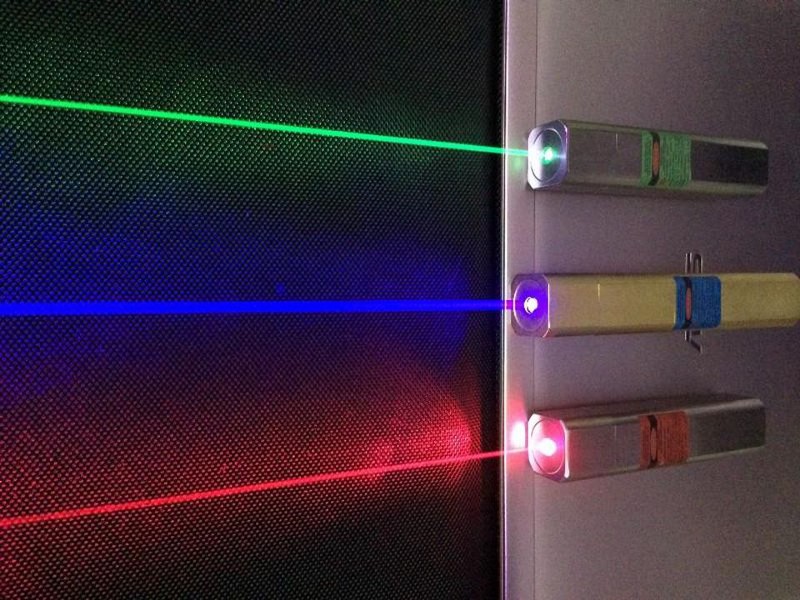 A set of Q-line laser pointers showcase the diverse colors and compact size that now are commonplace for lasers. By ‘pumping’ electrons into an excited state and stimulating them with a photon of the desired wavelength, you can cause the emission of another photon of exactly the same energy and wavelength. This action is how the light for a laser is first created: by the stimulated emission of radiation.
Credit: 彭家杰/Wikimedia Commons
A set of Q-line laser pointers showcase the diverse colors and compact size that now are commonplace for lasers. By ‘pumping’ electrons into an excited state and stimulating them with a photon of the desired wavelength, you can cause the emission of another photon of exactly the same energy and wavelength. This action is how the light for a laser is first created: by the stimulated emission of radiation.
Credit: 彭家杰/Wikimedia Commons
In our terrestrial laboratories, the way a laser works is both straightforward and remarkably informative, with applications that not only apply to the technologies that it enables, but to the larger Universe as well. Originally, laser was an acronym for Light Amplification by Stimulated Emission of Radiation, and the way it works is as follows.
- You start with a system, like an atom, a molecule, or a crystal, that has multiple allowable energy states.
- The electron moves (or is coaxed) into an excited state, one that has the potential to transition to the same lower-energy state every time.
- You then stimulate that excited state with a photon of the desired wavelength, causing the excited state to de-excite and emit yet another photon of the desired wavelength.
- And then you pump energy back into the system, causing the de-excited component to enter back into the excited state.
It’s these oscillations of the electrons — from the lower energy state to the higher one and back down again — where the last step causes the emission of a photon of a very specific wavelength, that leads to the coherent, monochromatic light that’s characteristic of a laser. Ironically, nothing is being amplified; rather, we’ve adopted the modern term laser because of the distaste that would come along with the acronym Light Oscillation by Stimulated Emission of Radiation.
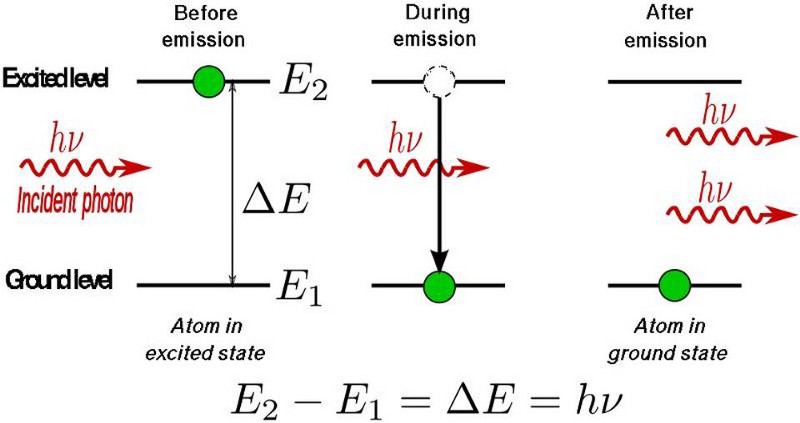 By “pumping” electrons into an excited state and stimulating them with a photon of the desired wavelength, you can cause the emission of another photon of exactly the same energy and wavelength. This action is how the light for a laser is first created. That light, depending on a variety of properties, can then be leveraged for many different purposes.
Credit: V1adis1av/Wikimedia Commons
By “pumping” electrons into an excited state and stimulating them with a photon of the desired wavelength, you can cause the emission of another photon of exactly the same energy and wavelength. This action is how the light for a laser is first created. That light, depending on a variety of properties, can then be leveraged for many different purposes.
Credit: V1adis1av/Wikimedia Commons
In laboratory experiments, one of the “holy grails” of laser physics is to get to the highest possible intensity of light, where intensity is energy per unit time per unit area. If you want a more intense laser, you have a few options to pursue. You can either:
- increase the total amount of energy in your laser,
- decrease the amount of time over which the energy in a laser “pulse” is emitted,
- or collimate your laser more pristinely, so that the beam intercepts a smaller area.
Laser light can either be continuously emitted or “saved up” and emitted in a single burst. The latter option has a number of important applications in physics, engineering, and technology. In fact, the fundamental technique used to achieve high-powered, short-period pulses without destroying the amplifying material was worth a share of the 2018 Nobel Prize. By creating relatively standard high-powered laser pulses, stretching them in time, amplifying the lower-power but time-stretched pulses, and then time-compressing the pulses again, an ultra-short, high-intensity laser pulse was created for the first time. Four years later, that technology was applied to achieve the vaunted breakeven point in fusion energy research at the National Ignition Facility.
The Nobel-winning research that led to that advance was a 1985 breakthrough, by Gérard Mourou and Donna Strickland, with the development of a technique known as chirped-pulse amplification. Since the arrival of that technique, laser power has increased by a factor of billions.
 Zetawatt lasers, reaching an intensity of 10²⁹ W/cm², should be sufficient to create real electron/positron pairs from the quantum vacuum itself. The technique that has enabled a laser’s power to rise so quickly was Chirped Pulse Amplification, which is what Gerard Mourou and Donna Strickland developed in 1985 to earn them a share of the 2018 Nobel Prize in physics.
Credit: Gerard A. Mourou, Toshiki Tajima, and Sergei V. Bulanov
Zetawatt lasers, reaching an intensity of 10²⁹ W/cm², should be sufficient to create real electron/positron pairs from the quantum vacuum itself. The technique that has enabled a laser’s power to rise so quickly was Chirped Pulse Amplification, which is what Gerard Mourou and Donna Strickland developed in 1985 to earn them a share of the 2018 Nobel Prize in physics.
Credit: Gerard A. Mourou, Toshiki Tajima, and Sergei V. Bulanov
In space, nature is incapable of exerting the type of control over a physical system to produce monochromatic, high-powered light like we routinely do on Earth. What does occur in those natural environments, however, is fascinating in its own right. All throughout the Universe, ever since the first generations of stars lived-and-died, the cosmos has not only been populated with hydrogen and helium, but all sorts of atoms. Oxygen, carbon, neon, iron, nitrogen, silicon, magnesium, and sulfur, for example, are the third-through-tenth most common elements in the Universe today.
This means that molecular bound states involving these atoms, particularly if they’re simple bound states, should be found in many locations naturally, including in the interstellar space separating the stars within a galaxy. Some of these bound states lend themselves to the stimulated emission of radiation, even in astrophysical environments, including:
- hydroxyl (OH),
- methylidyne (CH),
- formaldehyde (CH2O),
- water (H2O),
- ammonia (NH3),
- methanol (CH3OH),
- silicon monoxide (SiO),
- silicon monosulfide (SiS),
- hydrogen cyanide (HCN),
- and carbon monosulfide (CS).
All of these molecules, under the right physical circumstances, have been observed to emit stimulated emission in space.
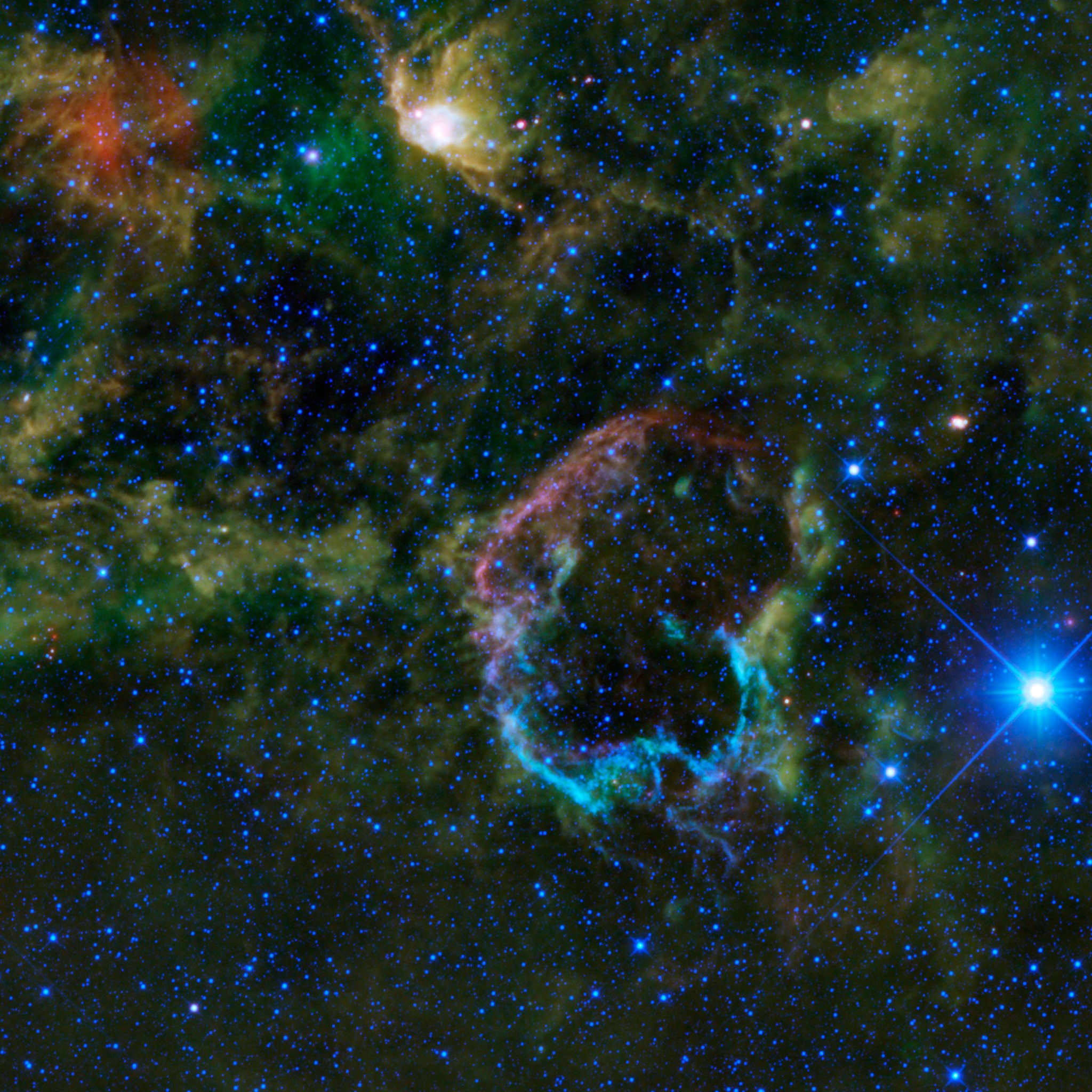 This colorful view of the supernova remnant IC 443 comes from NASA’s WISE telescope, and possesses emission lines from iron, neon, silicon, and oxygen atoms that were heated by the supernova. IC 443 is a naturally occurring megamaser as well, with the supernova shockwave and the interstellar gas colliding to produce it.
Credit: NASA/JPL-Caltech/WISE Team
This colorful view of the supernova remnant IC 443 comes from NASA’s WISE telescope, and possesses emission lines from iron, neon, silicon, and oxygen atoms that were heated by the supernova. IC 443 is a naturally occurring megamaser as well, with the supernova shockwave and the interstellar gas colliding to produce it.
Credit: NASA/JPL-Caltech/WISE Team
Unlike in terrestrial laboratory experiments, where masers have been created since 1953 (predating lasers by years, with the latter being known as “optical masers” before the “laser” acronym caught on), there is no possibility of a resonant or oscillatory cavity in space. All you can hope for, at best, is an energy source injected into some sort of “gain medium,” which is effectively just a pile of gas in space that gets excited to a higher-energy quantum mechanical level. When the molecules de-excite, monochromatic, microwave light is produced, resulting in what we might call a “single-pass laser,” as opposed to the more common laboratory-based oscillator-driven laser.
With oxygen being the third most common element (and hydrogen being the first) in the Universe, it’s no surprise that hydroxyl (OH) masers were the first ones discovered, followed by water, methanol, and silicon monoxide. Astrophysical masers require that these molecules exhibit a significant amount of velocity coherence, meaning that they’re all moving with roughly the same speed, otherwise we would observe radiative couplings between different parts of the gain medium.
The radiation produced by astrophysical masers is generally unpolarized, unlike laboratory-based laser light, with the only exception coming when the gain medium possesses a substantial magnetic field. And the radiation from masers is generally quite weak, as the surrounding unpumped molecules are often capable of absorbing practically all of the emitted maser light from the gain medium.
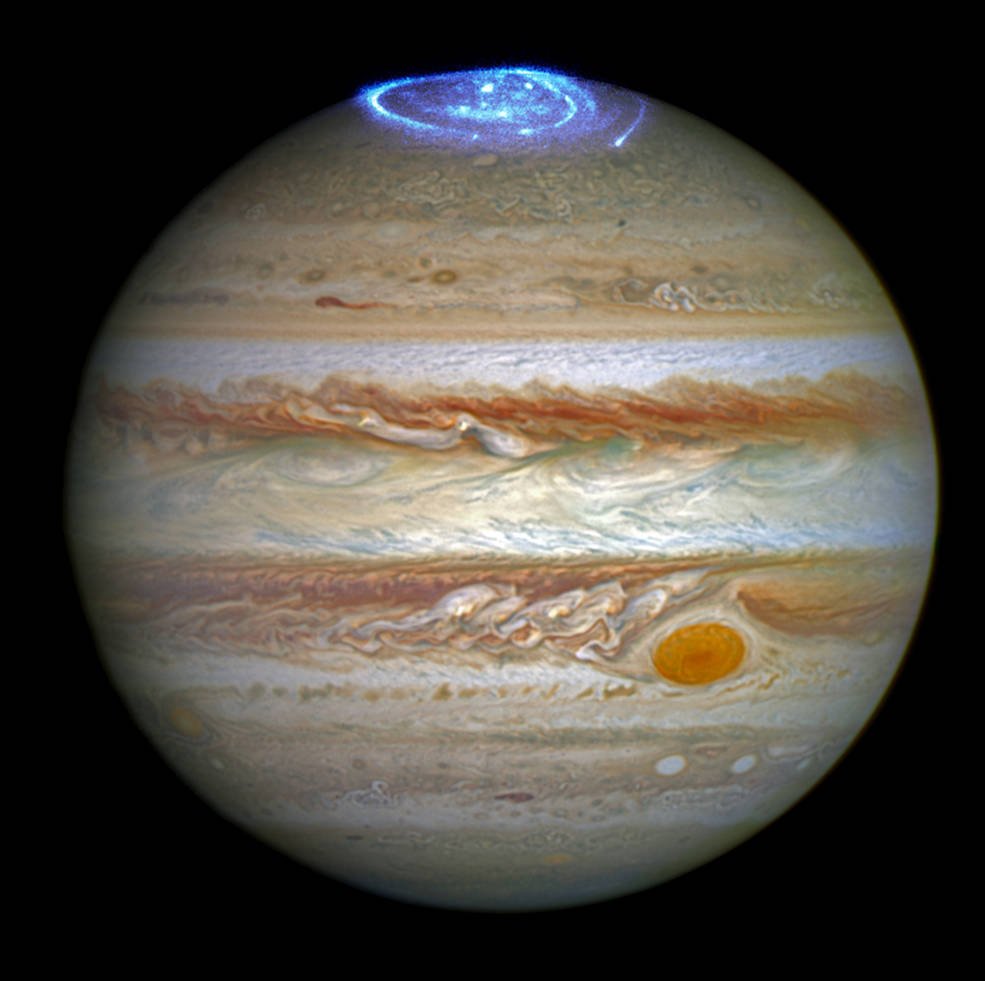 The northern polar aurorae seen on Jupiter, as imaged here with Hubble’s NICMOS camera, represents a cyclotron-driven maser: the first such one detected from a planetary body within our own Solar System.
Credit: NASA, ESA, and J. Nichols (University of Leicester)
The northern polar aurorae seen on Jupiter, as imaged here with Hubble’s NICMOS camera, represents a cyclotron-driven maser: the first such one detected from a planetary body within our own Solar System.
Credit: NASA, ESA, and J. Nichols (University of Leicester)
Based on all of this, you might think that you would need a highly specialized environment for a maser to exist and be detectable, but that turns out not to be the case at all. Masers have been detected:
- in the environments of comets, where vaporized volatile molecules create them,
- in the atmospheres of planets, such as when aurorae generate cyclotron masers,
- on the moons of the outer planets, where water masers have been detected in the plumes associated with Hyperion, Titan, Enceladus, and Atlas (although their presence here is disputed),
- in the atmospheres of highly evolved stars,
- in supernova remnants that interact with molecular clouds,
- and in star-forming regions, where young stellar objects and compact regions of ionized hydrogen gas produce the majority of astrophysical masers, including some of the rarest ones.
If you know something about star-forming regions, you might realize that the Milky Way itself isn’t remarkably rich in star-formation, but there are other galaxies that are. Therefore, you might think that a galaxy rich in ionized gas, like a merging galaxy, a starburst galaxy, or a galaxy with an actively feeding central black hole might be an excellent candidate for producing a maser of far greater power than we’d ever see within our own galaxy.
 This galaxy, IRAS 16399, contains a megamaser located some 370 million light-years from Earth. There’s a supermassive black hole, two cores, and a massive starburst region occurring inside, with the latter giving rise to a megamaser. After a starburst, some galaxies never form stars again; in others, star-formation will reawaken in time.
Credit: ESA/Hubble & NASA; Acknowledgement: Judy Schmidt (geckzilla)
This galaxy, IRAS 16399, contains a megamaser located some 370 million light-years from Earth. There’s a supermassive black hole, two cores, and a massive starburst region occurring inside, with the latter giving rise to a megamaser. After a starburst, some galaxies never form stars again; in others, star-formation will reawaken in time.
Credit: ESA/Hubble & NASA; Acknowledgement: Judy Schmidt (geckzilla)
As it turns out, these objects do exist, and produce enormous amounts of energy in comparison to the normal classes of masers that we see; they are known as megamasers. The first two types of megamaser ever discovered are also the most common ones:
- water (in 1979)
- and hydroxyl (in 1982).
The first hydroxyl megamaser system ever seen, interestingly enough, occurred in the peculiar galaxy Arp 220 (below). At 250 million light-years away, Arp 220 is remarkable in its own right: it’s the closest ultraluminous infrared galaxy in the known Universe. Ultraluminous infrared galaxies are bright, having more than one trillion times the luminosity of our Sun. They’re named “infrared” because they emit more energy in the infrared than in all other wavelengths combined, with the overwhelming majority of their brightness caused by the stars forming within these galaxies.
Arp 220 itself is the result of two precursor galaxies that collided just a few hundred million years ago, which now find themselves in the process of merging. A massive, recent burst of star-formation has occurred all throughout the galaxy: evidence of a starburst event. Hubble has imaged the central core of this galaxy, revealing hundreds of massive young star clusters, with the most massive containing around ten million solar masses worth of material: about 250 times more massive than the largest star-forming region in our Local Group. Arp 220 also contains two bright masers, with one being a hydroxyl maser and the other being a water maser, and an enormous amount of neutral gas: billions of solar masses worth.
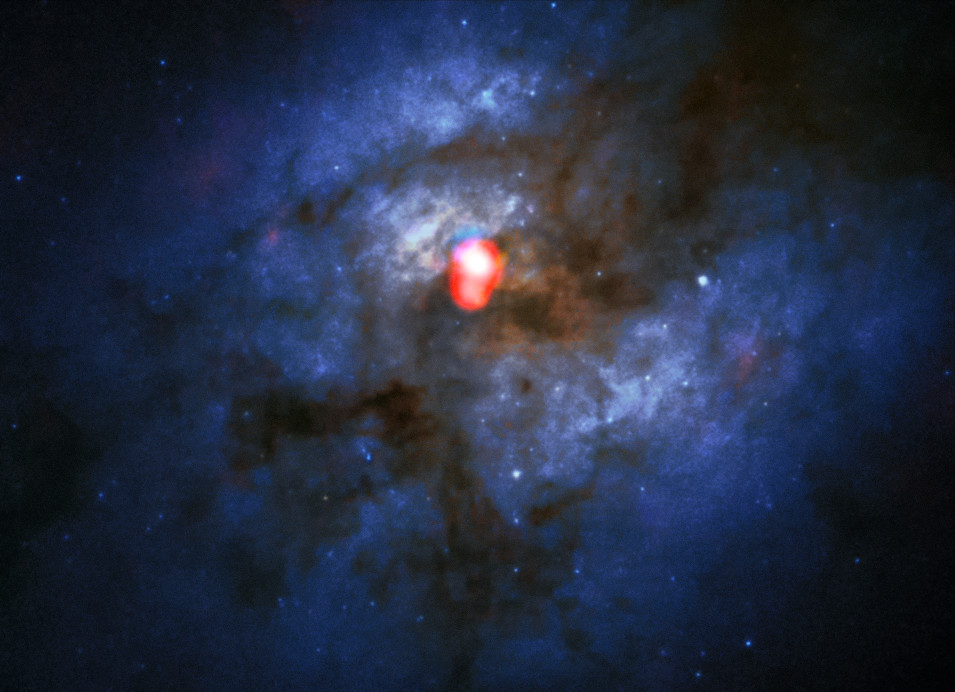 This composite Hubble (blue/white/dark) and ALMA (red) image shows not only the colliding galaxy system Arp 220, but also the double nucleus which contains the bright emission from both water and hydroxyl megamasers. Astrophysical masers rely on the same underlying physics as lasers, but were actually discovered prior to the 1958 invention of lasers in a laboratory.
Credit: ALMA(ESO/NAOJ/NRAO)/NASA/ESA and The Hubble Heritage Team (STScI/AURA)
This composite Hubble (blue/white/dark) and ALMA (red) image shows not only the colliding galaxy system Arp 220, but also the double nucleus which contains the bright emission from both water and hydroxyl megamasers. Astrophysical masers rely on the same underlying physics as lasers, but were actually discovered prior to the 1958 invention of lasers in a laboratory.
Credit: ALMA(ESO/NAOJ/NRAO)/NASA/ESA and The Hubble Heritage Team (STScI/AURA)
As it turns out, every hydroxyl megamaser that’s ever been discovered also is found within a luminous infrared galaxy, with the only differences between them being the size, mass, and brightness of both the galaxy and the megamaser. Typically, what’s thought to occur in these megamasers is a little bit different than in conventional masers, as the young starlight in these objects gets absorbed and re-emitted by the surrounding interstellar dust. (This is similar to how Earth absorbs sunlight of all wavelengths, but re-emits radiation in infrared wavelengths alone.) That re-emitted infrared light can then excite the hydroxyl molecules, which leads to the resulting megamaser emission.
Typically, hydroxyl masers within the Milky Way emit about 0.001% of the light of the Sun at those specific microwave maser frequencies. When Arp 220 was discovered, it was termed a “megamaser” because it’s approximately 100 million times as luminous as a typical maser. Today, there are over 100 known hydroxyl megamasers, and they all:
- are very rich in gas,
- have experienced recent galaxy mergers,
- have high molecular densities and high star-formation rates in their centers,
- and have copious amounts of dust that gets heated, causing a very high luminosity in the far-infrared part of the spectrum.
Up until this year, the farthest hydroxyl megamaser was discovered by Arecibo, at a distance of 3.7 billion light-years away.
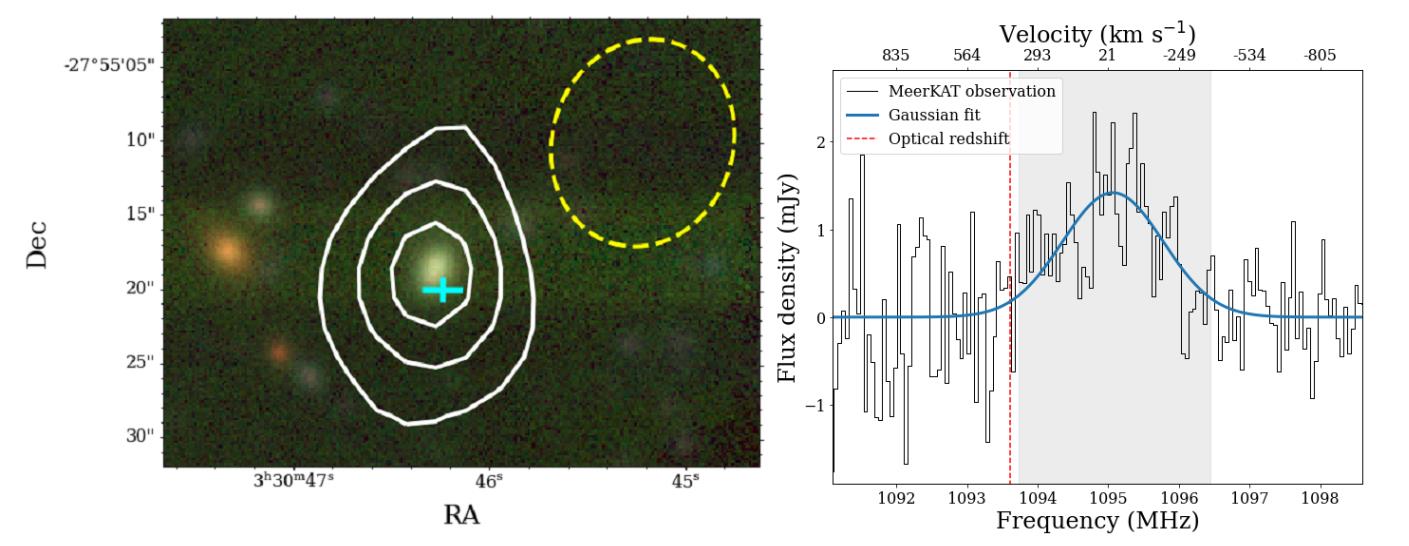 The ultra-luminous infrared galaxy that’s host to the detected hydroxyl megamaser Nkalakata, is shown alongside its redshifted spectral line. The data is exquisite, and represents something like an 18-sigma detection: an absolute certainty.
Credit: M. Glowacki et al., ApJ Letters accepted, 2022
The ultra-luminous infrared galaxy that’s host to the detected hydroxyl megamaser Nkalakata, is shown alongside its redshifted spectral line. The data is exquisite, and represents something like an 18-sigma detection: an absolute certainty.
Credit: M. Glowacki et al., ApJ Letters accepted, 2022
That record was shattered a few years ago, on April 6, 2022, when the preprint of a paper by the Looking At the Distant Universe with the MeerKAT Array (LADUMA) collaboration appeared. Eventually slated to be part of the Square Kilometer Array, a series of radio telescopes which will form the world’s largest network, the MeerKAT array contains 64 independent antennas that all function together. The LADUMA collaboration targeted a single patch of sky which encompasses the entire extended Chandra Deep Field South, targeting neutral hydrogen emission lines and serving as a complement to Chandra’s X-ray views, NASA’s WISE mission’s data, and the European Southern Observatory’s VISTA observations of the same region.
What they found, coincident with a galaxy at precisely a redshift of 0.5225, was a megamaser: the most distant and one of the most powerful ever seen. The astronomers named it Nkalakatha: after the Zulu word for “big boss”. The megamaser displayed an unambiguous emission line (above) that corresponds to the main hydroxyl emission line, normally seen at 1667 megahertz, redshifted to an observed frequency of 1095 megahertz. That’s exactly what you’d expect if you divided 1667 by (1 + 0.5225): a smoking gun for a (hydroxyl) megamaser signature. Exactly as expected, this galaxy did indeed turn out to be an ultra-luminous infrared galaxy at a distance of 6.6 billion light-years away, with a megamaser luminosity that’s 6300 times as great as the Sun’s total luminosity. Far and away, it’s the most distant megamaser ever seen, being almost twice as far away as the previous record-holder.
In fact, of all the megamasers ever discovered, this one was one of the most luminous both in terms of the brightness of the host galaxy and of the megamaser itself. At the time, it was the most distant laser ever seen in the Universe.
 Artist’s impression of a hydroxyl maser. Inside a galaxy merger are hydroxyl molecules, composed of one atom of hydrogen and one atom of oxygen. When one molecule absorbs a photon at 18cm wavelength, it emits two photons of the same wavelength. When molecular gas is very dense, typically when two galaxies merge, this emission gets very bright and can be detected by radio telescopes such as MeerKAT.
Credit: IDIA/LADUMA using data from NASA/StSci/SKAO/MolView
Artist’s impression of a hydroxyl maser. Inside a galaxy merger are hydroxyl molecules, composed of one atom of hydrogen and one atom of oxygen. When one molecule absorbs a photon at 18cm wavelength, it emits two photons of the same wavelength. When molecular gas is very dense, typically when two galaxies merge, this emission gets very bright and can be detected by radio telescopes such as MeerKAT.
Credit: IDIA/LADUMA using data from NASA/StSci/SKAO/MolView
But that record, which stood for nearly four years, was just broken once again! On February 13, 2026, a new preprint of an accepted paper was published that announced the discovery of HATLAS J142935.3-002836: a megamaser located a whopping 11 billion light-years away, at a redshift of z = 1.027, and from a time when the Universe was 8 billion years younger than it is today. It’s the new most distant natural laser ever discovered, and it confirms many of the expectations that arose in the aftermath of the earlier 2022 discovery. We’ve learned that:
- these megamasers really are out there ubiquitously,
- they can be found at higher redshifts and greater distances than they had ever been detected at previously,
- that MeerKAT is capable of finding and discovering them, and breaking many cosmic records,
- and that we can fully expect the number of known hydroxyl megamasers to continue to increase.
When the full Square Kilometer Array is finally completed, commissioned, and fully functional, we can then set a new expectation: that the distance record for farthest megamaser will be broken numerous times, again and again, in the coming years.
We can now be certain that there are megamasers out there at greater distances than we’ve ever seen before, which motivates us to search farther and deeper, and to continue building next-generation observatories to enable us to find what’s out there. We’re only just learning how galaxies grow and evolve in the Universe, and by adding megamasers into that equation, we’re poised to put together yet another vital piece of the cosmic puzzle.
This article was originally published in April of 2022. It was updated in February of 2026.
-
Science and TechAstrophysicsUniverse ExpansionAstronomyCosmology
Theoretical astrophysicist and science writer
Full Profile Monthly Issue
February 2026
Biology’s New Era
In this monthly issue, we explore the bleeding edge of biotech, as well as the scientists, writers, and philosophers whose efforts helped get us here.
1 video
10 articles
Monthly Issue
February 2026
Biology’s New Era
In this monthly issue, we explore the bleeding edge of biotech, as well as the scientists, writers, and philosophers whose efforts helped get us here.
1 video
10 articles

Related Content
Starts With A BangRecord-breaking supernova manages to “X-ray” the entire Universe
The first supernova ever discovered through its X-rays has an enormously powerful engine at its core. It's unlike anything ever seen.
by Ethan Siegel Starts With A Bang
“Farthest galaxy ever” HD1 is probably not what it seems
We've fooled ourselves before with galaxies that look just like this one. The evidence we have simply isn't strong enough.
by Ethan Siegel Starts With A Bang
Ask Ethan: Where are we located relative to the Big Bang?
If you think of the Big Bang as an explosion, we can trace it back to a single point-of-origin. But what if it happened everywhere at once?
by Ethan Siegel Starts With A Bang
Record-breaking Pantheon+ supernova study reveals what makes up our Universe
With 1550 distinct type Ia supernovae measured across ~10 billion years of cosmic time, the Pantheon+ data set reveals our Universe.
by Ethan Siegel Learn from the world's biggest thinkers.
-
Videos
- Latest
- The Big Think Interview
-
Columns
- Mini Philosophy
- Starts with a Bang
- Big Think Books
- The Long Game
- Strange Maps
- 13.8
- The Well
- Rethinking Possible
-
Sections
- Philosophy
- Mind & Behavior
- Science & Tech
- Business
- History & Society
-
Classes
- Class Library
-
Subscribe
- Membership
- Free Newsletters
-
Partner
- Big Think+ Learning
- Creative Studio
- Advertise with Us
- Events
-
More
- About
- Careers
- Contact
- Privacy Policy
- Terms of Sale
- Accessibility