 (Credit: madscinbca via Adobe Stock)
Key Takeaways
(Credit: madscinbca via Adobe Stock)
Key Takeaways
- Since 2016, hundreds of U.S. government personnel have reported suffering strange symptoms, often while working abroad, linked to a condition commonly called “Havana syndrome,” which some believe is caused by “directed-energy” weapons.
- The perpetrators of the alleged attacks remain unclear, though some U.S. officials and media investigations have pointed to Russian operatives. Russia has denied the accusations.
- A new report from CNN states that the Department of Homeland Security purchased a device that some government sources think is linked to cases of Havana Syndrome.
Since 2015, more than 1,000 U.S. government personnel working across the world have reported symptoms linked to Havana Syndrome, an acute illness marked by sudden headache, nausea, and the hearing of loud sounds, akin to swarming cicadas. The cause of the illness, officially called “anomalous health episodes,” remains a mystery. But some U.S. government workers and researchers have long alleged that the cases were caused by foreign adversaries using some type of “directed-energy” weapon, possibly firing pulsed radio waves, against American personnel.
U.S. intelligence agencies have generally disagreed. In 2025, the National Intelligence Council released a report stating that most agencies found it “very unlikely” that a foreign adversary was responsible for the cases or had developed a novel weapon capable of causing such effects.
But now, a new report from CNN suggests the U.S. has acquired a device that “some investigators” believe could explain some of the cases, though there’s still no definitive proof regarding who or what caused the incidents.
The report states that the Defense Department has spent a year experimenting with a device that produces pulsed radio waves, reportedly purchased near the end of the Biden administration by a division of the Department of Homeland Security for an eight-figure sum during an undercover operation. An anonymous source told CNN that the device could fit in a backpack and “contains Russian components.”
The report suggests U.S. intelligence agencies still lack a clear consensus on whether such a device is linked to Havana Syndrome.
One of the first cases was reported in Havana, Cuba, in 2017. The victim, if it indeed was an attack, was a U.S. Foreign Service officer who was living in a quiet Havana neighborhood among other American personnel. One night, she was cleaning her kitchen. If it had been daytime, her kitchen window would have offered a view of a booth outside where Cuban police monitored foreigners like herself.
But at night, the kitchen’s interior lights obstructed her view of the booth, The New Yorkerreported. As she was cleaning, she suddenly felt a painful burst of pressure inside her head. The pain grew. She had heard rumors of U.S. personnel suffering strange “sonic attacks,” and she remembered that a security officer had once advised: to protect yourself, step away from your current position. She did. The pain decreased. But for weeks, she suffered headaches, dizziness, and confusion.
Over the past decade, U.S. personnel have reported similar symptoms while working in places like China, Russia, and Washington, D.C. The cases vary in severity, but almost all involve sudden headaches and nausea. Some victims have shown neurological abnormalities. A 2019 study published in JAMA found that victims had “significantly smaller” white matter volume and other “significant differences” in brain structure, though it’s impossible to determine whether these differences were pre-existing or stem from a directed-energy attack. As of 2024, more than 300 U.S. government employees with symptoms linked to Havana Syndrome had qualified for care in the military health system.
What’s causing Havana Syndrome?
The U.S. hasn’t reported a definitive cause of these cases, but intelligence agencies have investigated the possibility that bad actors are using some type of directed-energy weapon against U.S. personnel.
A December 2020 report from the National Academies of Sciences found that pulsed radiofrequency energy, which includes microwave radiation, “appears to be the most plausible mechanism in explaining these cases among those that the committee considered.” (Other potential causes included infection and chemicals.)
In January 2022, the C.I.A. announced the interim results of a study on cases of alleged directed-energy attacks. Those results suggest most cases can be explained away by less exotic factors like stress, environment, and undiagnosed illnesses. Still, the agency said that roughly two dozen cases are more difficult to explain, and that some form of attack from a directed-energy weapon remains a potential explanation.
A microwave weapon could be a fitting culprit for these cases. One reason is that sufferers of Havana Syndrome often hear loud noises, a phenomenon known to occur when people are bombarded with high-powered microwaves. In the 1960s, the American neuroscientist Allan H. Frey demonstrated that exposing people to microwaves can make them hear buzzing, clicking, hissing, and speech — even though the microwave device didn’t produce any soundwaves. It was all, quite literally, in their heads.
How is that possible? Researchers have hypothesized that the noises are induced by thermoelastic expansion of bones and soft tissue in the body: As microwaves strike people, they slightly warm the body, which causes expansion. This expansion might produce sound waves that travel to the ear. Frey and other researchers have proposed different theories about which parts of the body are expanding — those in the head, or those in the ear — but the principle is the same.
To induce auditory effects, a pulsed-microwave weapon needs to transmit 40 joules per square centimeter, according to a U.S. Army report. How much energy is that? Here’s how astrophysicist Dr. Ethan Siegel explained it to the American Council on Science and Health (ACSH): “If you are talking about 40 J/cm2 over the entire human body, that’s about as much energy as a fully loaded Harley Davidson going 100 mph.”
The Moscow Signal
We know that similar weapons exist, or at least did at one time. During the Cold War, the Soviet Union fired microwaves at the U.S. embassy in Moscow from a nearby apartment building for more than two decades, from 1953 to 1976. The event was dubbed the Moscow Signal.
U.S. intelligence officials initially thought the Soviets were firing the microwaves in an attempt to control the minds of American personnel, but they later reasoned that the Soviets were trying to activate espionage devices inside the building or interfere with the health of the diplomats. To this day, “many questions remain unanswered” about the long-term health effects incurred by Americans who worked at the U.S. embassy in Moscow, according to a 2019 review.
 U.S. Embassy in Moscow, Russia. (Credit: Dzerod via Wikipedia)
A more recent example of an energy-directed weapon is the active denial system, an American technology that uses non-lethal millimeter waves for crowd control. These waves, which the U.S. says are not classified as microwaves, cause a painful heating sensation on the skin. The U.S. is also developing or has developed stronger directed-energy weapons, including microwave weapons that can destroy electronic systems from a distance.
Still, if energy-directed weapons are indeed causing Havana Syndrome, what they look like and how they operate remains a mystery. Some critics have suggested that, while it’s possible that directed-energy weapons do exist, no such technology is currently available publicly, and, further, some of the technological requirements for these weapons — a sufficiently strong power source, for example — would make them impractical to use.
Who’s behind the alleged directed-energy attacks?
There’s currently no “smoking gun” evidence for who’s responsible for the alleged attacks. But in December 2020, the CIA established a task force to investigate the more than 130 reported cases of Havana Syndrome among U.S. personnel. In April 2022, former President Biden’s administration released a statement:
“The White House is working closely with departments and agencies to address unexplained health incidents and ensure the safety and security of Americans serving around the world. Given that we are still evaluating reported incidents and that we need to protect the privacy of individuals reporting incidents, we cannot provide or confirm specific details at this time.”
Although the U.S. hasn’t officially announced suspects, an anonymous former national security official involved in investigations told Politico that Russia is likely behind the attacks. Specifically, the official pointed to Russia’s foreign military intelligence agency, commonly called the GRU, whose operatives were present in the locations where American personnel have reported Havana Syndrome.
“It looks, smells, and feels like the GRU,” said the official. “When you are looking at the landscape, there are very few people who are willing, capable and have the technology. It’s pretty simple forensics.”
In 2024, 60 Minutes, The Insider, and Der Spiegel shared the findings of their five-year investigation into Havana Syndrome, reporting that they’d found evidence that a Russian military assassination unit may be behind the attacks. A Kremlin spokesperson denied the allegations.
Why Russia would carry out these attacks remains unclear. But the cases had a measurable impact on U.S. foreign policy, namely a 50% personnel withdrawal from the American embassy in Cuba in 2017, a nation that’s long been allied with Russia.
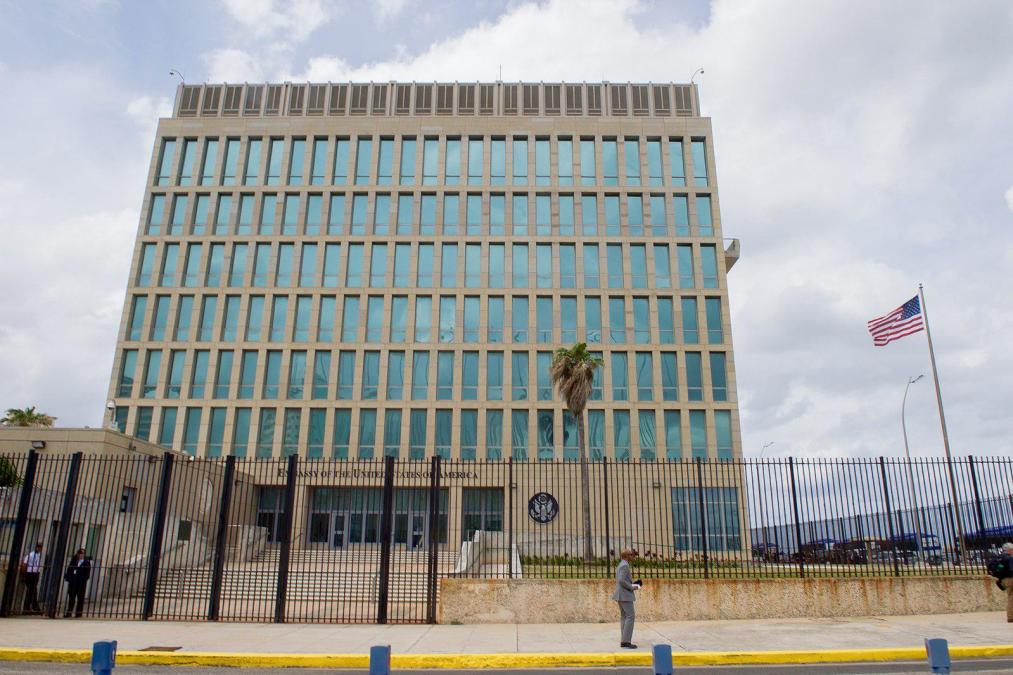 U.S. Embassy in Cuba. (Credit: U.S. State Department)
While U.S. intelligence agencies now seem to be taking these threats seriously, that wasn’t always the case. In the first few years after Americans first reported Havana Syndrome, some officials were skeptical of the idea that a foreign adversary would launch such brazen attacks, especially on U.S. soil. Some current and former officials say this skepticism has come at the expense of U.S. personnel.
In a 2022 statement, the Advocacy for Victims of Havana Syndrome group said the C.I.A.’s statements on the interim study results “cannot and must not be the final word on the matter.”
“The C.I.A.’s newly issued report may be labeled ‘interim’ and it may leave open the door for some alternative explanation in some cases, but to scores of dedicated public servants, their families and their colleagues, it has a ring of finality and repudiation,” the statement said.
Marc Polymeropoulos, a former CIA officer who reported being struck by Havana Syndrome in a Moscow hotel room in 2017, told the New York Times about a painting created by a fellow CIA officer and Havana Syndrome victim. Called The Gunshot, the painting depicts a red splatter on a black background.
“It signified his feeling that we all wished we had been shot, a visible injury, so that our colleagues would more readily believe us.”
This article was originally published on May 25, 2021. It was updated in January 2026.
Tags Current Eventsgeopoliticshealthparticle physicsTech Trends In this article Current Eventsgeopoliticshealthparticle physicsTech Trends Sign up for Big Think on Substack The most surprising and impactful new stories delivered to your inbox every week, for free. Subscribe