The exhibition at the Museum of the African Diaspora moves between history and futurity without settling on a singular narrative of the universe, instead prompting reflection.
 Alexandra M. Thomas
January 14, 2026
— 4 min read
Alexandra M. Thomas
January 14, 2026
— 4 min read
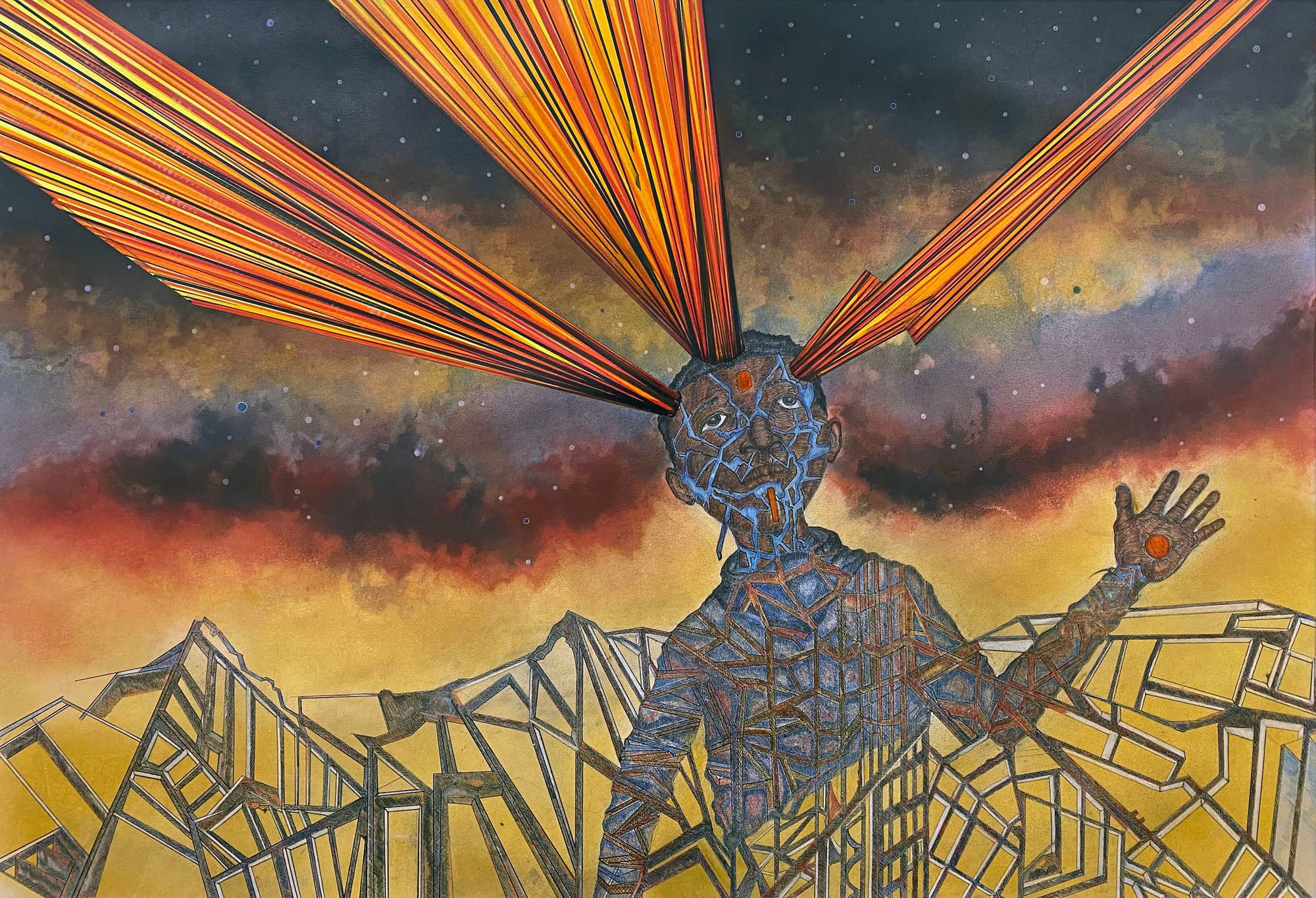
 Rodney Ewing, "Celestial Mechanics" (2023), dry pigment, colored pencils, and ink on paper (courtesy Rena Bransten Gallery, San Francisco, and the artist)
SAN FRANCISCO — Unbound: Art, Blackness, & the Universe at the Museum of the African Diaspora (MoAD) is deeply attuned to the forces of the cosmos. Spanning all three floors of MoAD, the exhibition explores how African and African diasporic artists imagine, remember, and conjure ancestral and futuristic notions of the universe.
The show opens with a pairing of early- to mid-20th-century wooden sculptures from West Africa: an elongated figure by a Dogon artist and an Oshe Sango ceremonial staff by a Yoruba artist. The wall text encourages contemplation of the works in relation to the theme: “What happens if you begin your journey through the exhibition by imagining your own body as a map of the cosmos, and ritual objects as technologies that connect you to ancestors, deities, and the universe itself?” The Dogon figure’s verticality situates the body as a cosmological axis between earth and sky, while the Oshe Sango staff’s dual form depends on ritual touch and movement to activate Sango’s thunderous forces of justice and order.
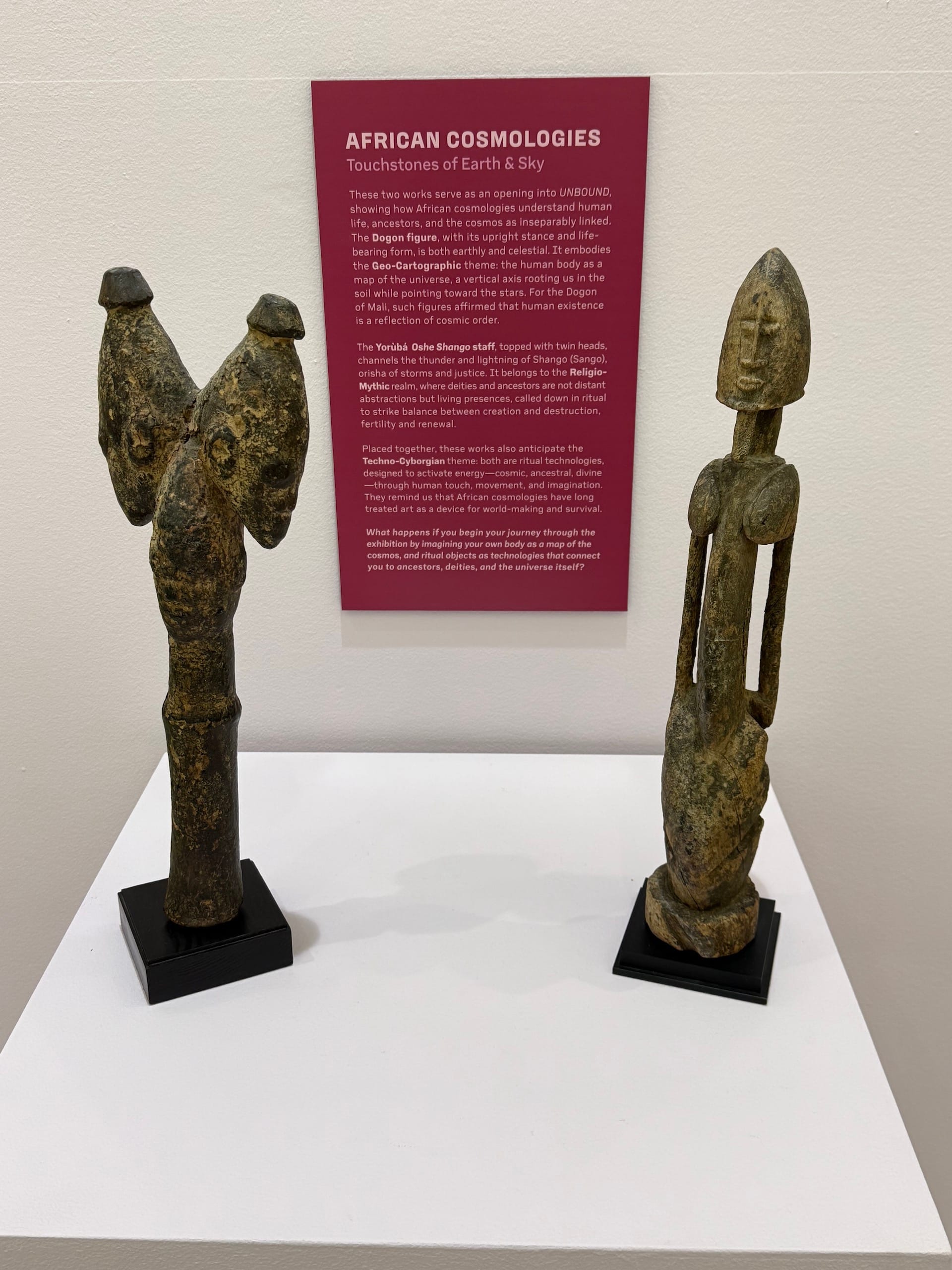 Dogon artist, “Figure” (early to mid-20th century), wood, and Yoruba artist, “Oshe Sango Ceremonial Staff” (early to mid-20th century), wood (photo Alexandra M. Thomas/Hyperallergic)
 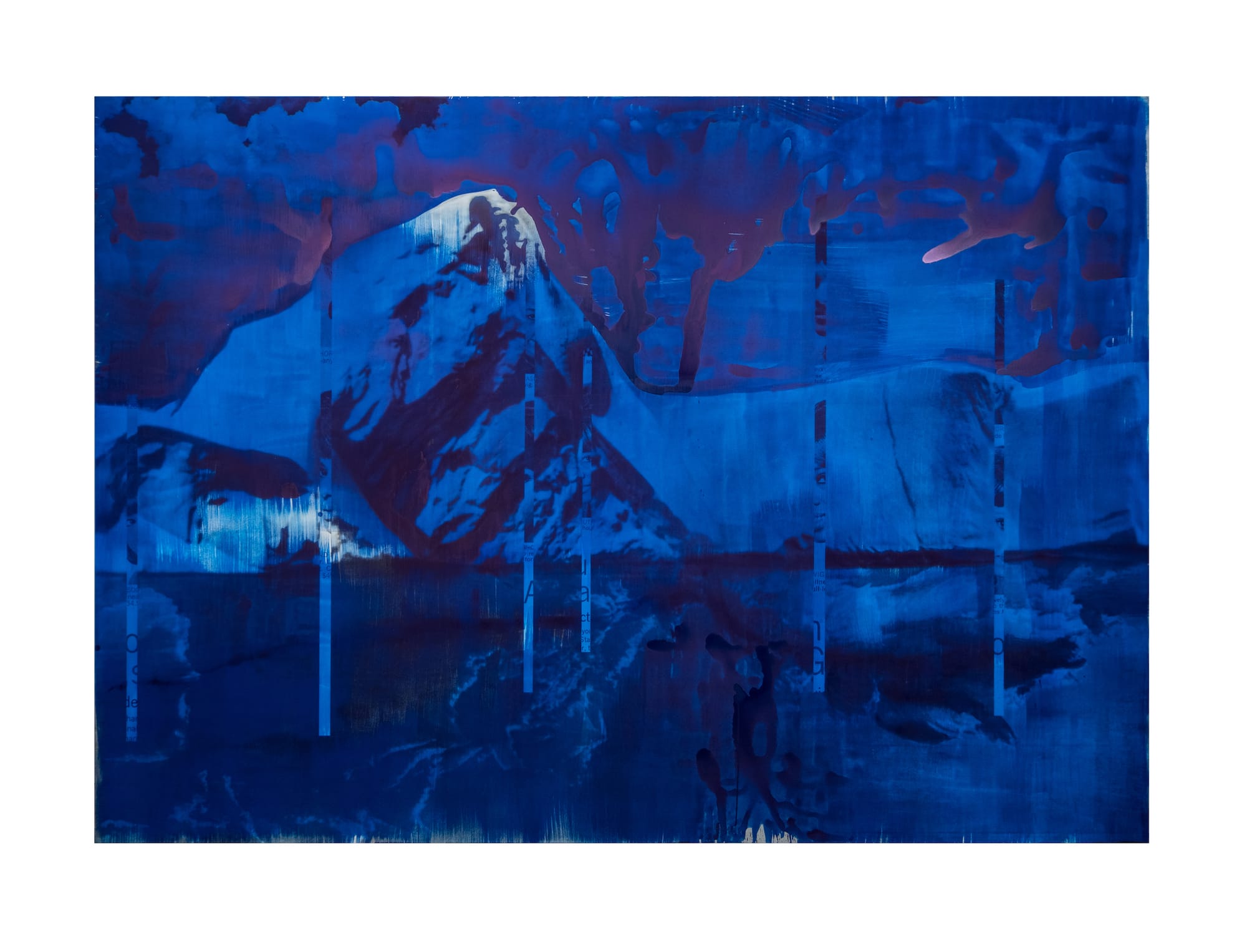 Lorna Simpson, "Blue Turned Temporal" (2019), ink, watercolor, and screenprint on gessoed fiberglass (photo by James Wang, Courtesy Dallas Museum of Art, TWO x TWO for AIDS and Art Fund)
Mikael Owunna's radiant photographs of people whose bodies are hand-painted with celestial patterns wrap the interior of the hallway and elevator, adding an immersive element to the show. In this way, passing through the building feels like an intergalactic threshold in which the figures in Owunna’s photographs shimmer and hover against the dim corridor.
Upstairs, Harmonia Rosales’s painting “Creation Story” (2021) depicts a confrontation between the orishas Yemayá and Obatalá in Yoruba cosmology. Yemayá, associated with the sea, appears as a nude Black woman reclining along the shoreline. Above her, Obatalá, the orisha charged with creating land, descends from the sky, pouring sand to form the Earth's surface. Rosales’s composition echoes the theatrical gestures and suspended bodies of the Sistine Chapel frescoes, placing a Yoruba creation story within a European Renaissance visual language.
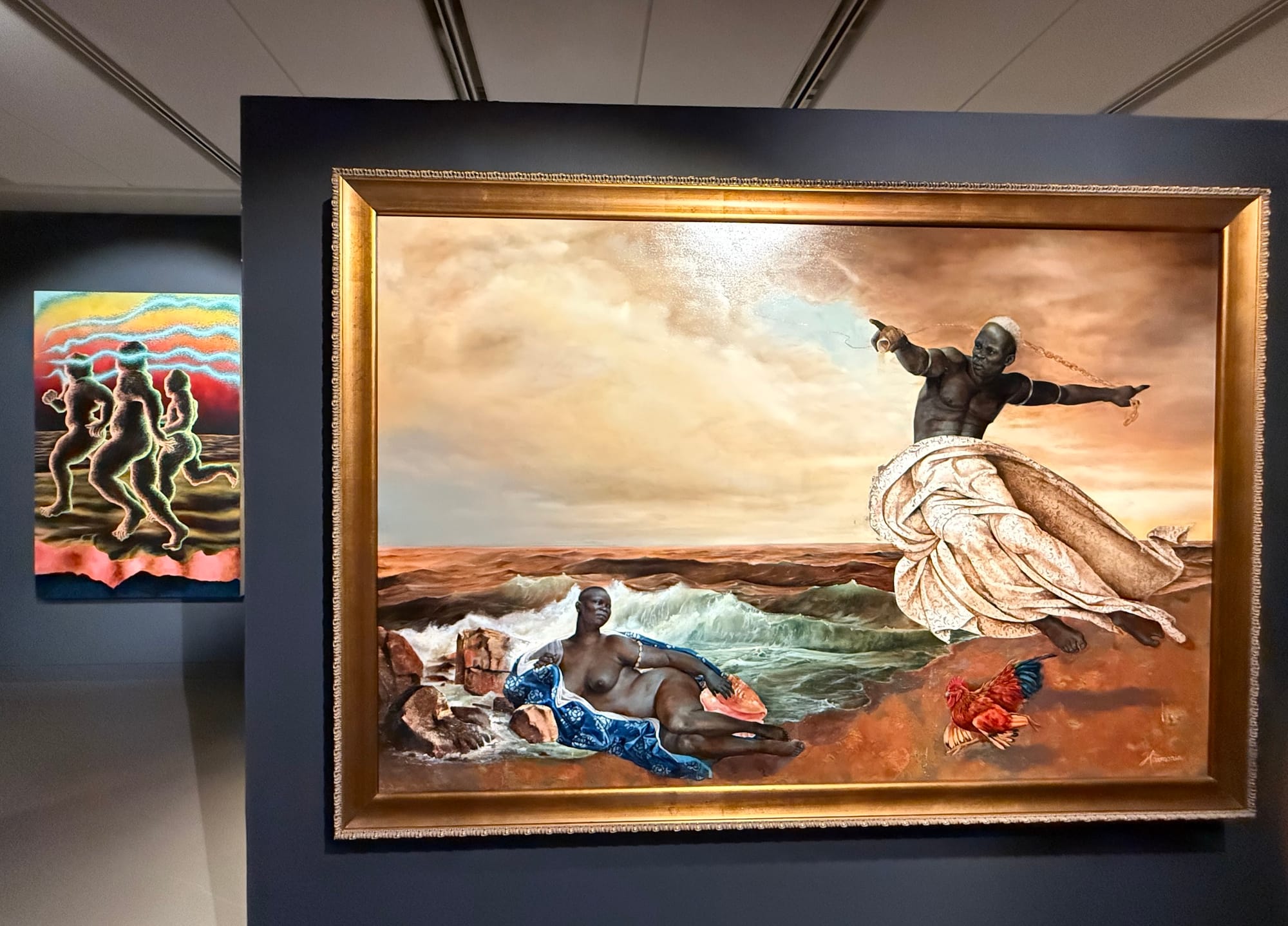 Foreground: Harmonia Rosales, “Creation Story” (2021), oil and genuine silver leaf on wood panel; background: “Dark Shores” (2024), acrylic, ink, oil, and wood carving on panel (photo Alexandra M. Thomas/Hyperallergic)
 In the corner of the gallery, Didier William’s “Dark Shores” (2024) shows three silhouetted bodies traced in electric green, moving together on a dark, rippling ground. Above them, the sky, gradating from deep crimson to orange-yellow, radiates outward, traversed by wavering streaks of color as the landscape vibrates with horizontal motion. Frozen mid-stride, the figures appear futuristic even as they allude to diasporic movement and past events, such as the artist's migration from Haiti to the United States as a child.
On the top floor, Gustavo Nazareno’s monumental triptych, “The Secret Matrices of Creation” (2025), invokes Afro-Brazilian cosmology, particularly Candomblé, through reimaginings of the orishas, who emerge gradually from shadow into small patches of soft light, their bodies shrouded in fabric.
 Gustavo Nazareno, "The Secret Matrices of Creation" (2025), oil on linen (Everton Ballardin © Courtesy GUSN Studio and Opera Gallery)
 Oasa DuVerney, “Black Power Wave as Bodhisattva Manjushri Sankofa” (2023), graphite on hand-cut paper (courtesy the artist and Welancora Gallery)
Nearby are evocative graphite drawings of sacred subjects from Oasa DuVerney's Black Power Wave series. In “Black Power Wave as Bodhisattva Manjushri Sankofa” (2023), two dark, monochrome seated figures mirror each other, set against an airy, undulating gray backdrop. Manjushri, the Buddhist bodhisattva associated with wisdom, and Sankofa, the Akan concept of looking back to move forward, appear as mirrored figures, both oriented toward knowledge carried across time.
Unbound moves between history and futurity without settling on a singular narrative of the universe. Wall texts punctuate the galleries with open-ended questions, prompting reflection on how knowledge of the cosmos is shaped through perception and imagination. Rather than defaulting to secular, Western scientific frameworks, the exhibition leaves room for aesthetic, spiritual, and political ways of conceiving the universe.
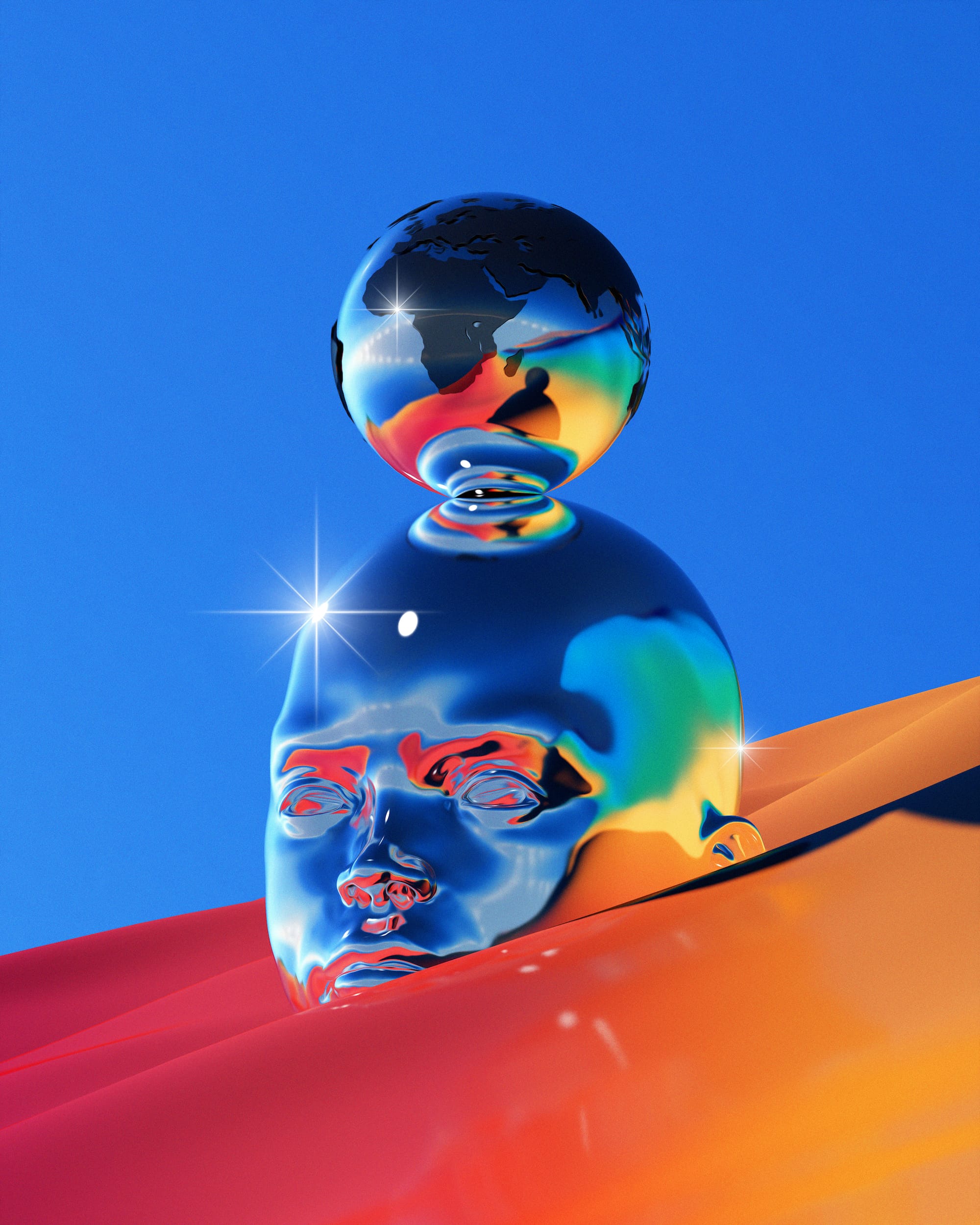 David Alabo, "The Boy Who Held the World on His Head" (2020), archival pigment print on Hahnemühle photo rag (courtesy the artist)
Unbound: Art, Blackness & the Universe continues at the Museum of the African Diaspora (685 Mission Street, San Francisco, California) through August 16. The exhibition was curated by Key Jo Lee.